Category: God

  • Us. Together.

    chores

    A few days ago I was cleaning the house. The floor needed cleaning so I grabbed the broom and began to sweep. Claire has a toy broom and dust pan that her grandma bought her that she keeps by her toy kitchen. As soon as Claire saw me sweeping in the hall she ran over to her kitchen and grabbed her own broom. I saw her do this and thought to myself, “if only I could train her to cut the grass.”

    Claire came over to the hall where I was and she began to sweep with me. At first it was cute, but then Claire began to get in the way. The pile of dirt, dog/cat hair I had collected was being knocked around. I guided Claire so that she could use her broom and collect the dirt. For the most part she understood and moved the dirt towards the direction I was sweeping. It wasn’t perfect, orderly or neat but she did it. After a few seconds of this she would inevitably kick the dirt pile or drop the broom and make a mess.

    The neat freak in me wanted to pick my daughter up and move her to another part of the house so that I could finish sweeping. However, I recognized that efficiency was not the important thing here. My child collaborating in my work was.

    Us. Together.

    We had to stop, go back, re-sweep, and re-sweep again. By the time we finished sweeping it had taken 10 times longer than usual. Even then you could still see some of the places we had missed.

    What would happen if God decided to do everything on His own? If instead of letting us collaborate with Him, He picked us up and moved us to another room? Sure it would all get done in half the time, it would be perfect, but something would be missing…us.

    As my daughter got in front of me and knocked around my carefully collected pile of dirt I recognized that God is constantly inviting us to collaborate with Him—to join Him in His work. If He wanted to, God could do the work on His own. We usually get in the way of His plans and knock things around, etc. Yet I think He prefers it this way—us, together. I don’t think He prefers the messiness of it, or the fact that we can really screw things up. I do think however that the messiness and those screw-ups, etc. are tolerable because it is done together. As I stare at my daughter joining me in the work of our home I cant help but want her there; to serve with me; to create with me; even if it isn’t perfect.

    Us. Together.


  • Daddy’s Lap

    20140627-220424-79464189.jpg
    Claire is on my lap. We are in an doctor’s waiting room. She cries and screams because she is in pain. I hold her on my lap soothing her, living with her pain. It hurts me more emotionally and spiritually than it does her physically, that I know for sure. I rub her legs and run my fingers through her curly hair. I hold her tight against my chest and whisper, “Daddy is here. It’s going to be okay.” Claire calms down and then moves away from me as if trying to deal with the pain on her own. She stops, cries, and runs back to me. I begin the comforting process again.

    While Claire is on my lap I am able to soothe her. The pain is still present and will not go away. However, I am with her through the pain. Somehow this makes a difference.

    Her father is present in a very real way and going through this pain with her.

    This isn’t the first time you have encountered this story. This is your story. Our story. You have had pain: emotional, spiritual, and physical. You have hurt, been upset, maybe even cried. As I held Claire in that room I recognized very clearly that the pain we experience often doesn’t make sense, at least not right away and maybe never on this side of heaven. The pain is there but so is our Father. In my imperfect fatherhood I am able to recognize God’s Fatherhood. My fatherhood is an image of His. My love for Claire is powerful because it is based on His Fatherhood.

    Maybe it is tough as a man to picture yourself as a child on the lap of God the Father. Think of the times you have held your child on your lap. You can’t take the pain away but you can live in the pain with them. Our Father does the same thing. He isn’t taking the pain away, but He will endure it with you. Most of the time you and I jump out of the Father’s lap and try to deal with the pain on our own terms. Instead of coming back to Him like my daughter did we run away and find other ways to cope with the pain. Some of these ways lead to more pain. I think God the Father is waiting for us to run back to Him so that he can rub our legs, run His fingers through our hair, hold us tight against His chest, and whisper, “Daddy is here. It’s going to be okay.”

    May we have the humility, wisdom, and desire to let Him take care of us in the deepest of pains.

  • Beams

    beam

    Yesterday I finished putting together a boxed perimeter around my daughter’s little playground area in our yard. It consisted of a couple of 6x6x12, and other similar sized beams and some metal stakes to connect them. Eventually we will fill it with rubber mulch and put her swing set on top of it. It took me about three days total to put the beams together.

    As I was buying the beams at Home Depot I couldn’t help but realize how heavy these things were. As I began to assemble the box perimeter in the yard there were a few times when I dropped the beams, stumbled carrying them or got a splinter from them. These beams were crazy heavy and big—twelve feet of anything is going to be heavy!

    It was a labor of love for my daughter.

    Yesterday was Good Friday. All of Christianity celebrated the death of its savior, Jesus. As I assembled these beams I had this reality on my mind. Jesus carried his beams. The wood was heavy and as I moved, dropped and dragged it I was reminded of Jesus journey to Calvary. After the beams were set the metal stakes were driven through the wood to connect them. My hammer struck the metal stakes and clinked, each time reminding me that metal stakes are what held my Lord on His beam.

    Clink, clink, clink.

    As I drove the last stake I got up exhausted. “It is finished,” I thought. I looked onto these wooden beams and found satisfaction. “My daughter will find so much happiness and joy playing here.” I wonder if this is what God the Father thought as He looked on His son and His beams? “My children will find satisfaction through this.” I never expected to have such an awesome, prayerful experience building this wooden box for my daughter. It was truly a gift.

    May we see that the beauty of the cross, though filled with pain, exhaustion, and blood, was a labor of love. May we discover more than just our own fatherhood.

  • Dust

    lent-7-easter1
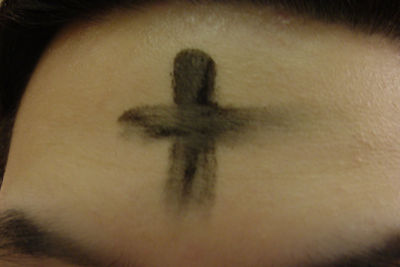
    Today is the beginning of Lent and in the Catholic Church it begins with going to Mass and having ash put on your forehead with the following words said, “Remember that you are dust, and to dust you shall return”.  It is kind of a weird thing to say, but it is a physical symbol of death. We recognize that we were created out of the dust and that we will die and become dust again.

    There is nothing like the reality of death to put things into perspective.

    Death is that inevitable elephant in the room that no one really wants to talk about. Death is very real and it will come to all of us. If you have ever spoken to someone who is dying they will usually talk about things like family, friends, relationships they had. Rarely does a dying person talk about wanting to get the latest iPhone or regretting not having more stuff. Death pushes away the junk of life and prioritizes it.

    Thankfully I am not dying, but I still need to prioritize, reflect on my relationships—the things that are really worth living for. Lent begins with dust—death—but more importantly Lent ends with life, new life. A life that is better than the one we have. At the end of Lent we have Easter, the empty tomb, resurrection—New Life.

    Lent is an intense time of prayer, repentance, sacrifice, reflection, denial, surrender to God, acceptance of our weakness, recognition of blessings, etc. At the end of Lent I should have a new focus, a renewed desire for all that is most important: God and family. Not stuff.

    My wife and daughter need a husband and father that is being purified of all that is not good. They deserve the very best of me and I can’t give them that if I don’t take stock of where I am and focus on the important things of life. It’s too easy to get distracted and knocked off course. That is why I love having Lent every year to help me refocus.

    I think that if every father took these next 40 days to pray, reflect, repent, sacrifice, deny, surrender to God, accept our weakness and recognize all our blessings we would be better men. The men our families deserve, the men God has called us to be. In the end we will all face death…return to the dust. I hope that we can all face death joyfully, with the understanding that it isn’t the end but the beginning of something great, a New Life.

    May this Lent transform us all!

  • Nails

    Hands and feet

    One of the more challenging things I do with Claire is trimming her finger and toenails. I remember the first time I did it. It was traumatic—for me. I had the clippers out and was able to get a few fingernails in a half hour. I was so scared I would take a chunk of her finger! I didn’t take a whole finger, but unfortunately I got a little bit of skin and it bled. Man talk about feeling like a bad father.

    At 10 months old trimming her nails isn’t a traumatic experience anymore, but it is still challenging. I find myself giving her shinny things to look and hold with one hand, while I try and trim her nails with the other. It is a bit rough to say the least. Claire is able to twist, turn and yank her limbs away all while screaming at the top of her lungs. I guess this is why surgeons have anesthesia.

    A few days ago we were at it again (I swear they grow overnight). Claire fought like a mad woman. I would try to calm her with monkey noises (one of her favorite sounds), handing her a tiny flash light we keep by her crib, and finally by trying to reason with her. The monkey sound was the only slightly successful tactic. At one point I pinned her down and tried overpowering her, but quickly realized that this would only lead to more trouble.

    Force never works.

    As I stood frustrated over Claire, clipper in one hand and pinning her with the other I came to the realization that Claire’s attempts to keep me from trimming her nails is something I do…with God.

    God is constantly speaking to us—even to those of us who believe He isn’t there. God is constantly trying to steer us towards Him and all that is good. God does all He can to help us to see that what He has to offer is what we need. I’m sure God has His own monkey noises for us; shinny things to attract our attention and heaven forbid He would try to reason with us. I know I fight Him just as much as Claire fights nail trimming.  Claire’s nails must be trimmed so she doesn’t hurt herself, but she will fight it. There are things in my life that must be “trimmed” yet I fight it.  I kick and scream and in the end the only thing I’ve done is cut myself with my own nails.

    I often wonder how incredibly frustrating it must be to be God. To have a bunch of whinny, difficult and crazy children that reject every good and perfect thing He offers. It must be exhausting and infuriating. As I think these things Claire smiles as she lies pinned down by my hand.  I smile back and realize that even in Claire’s fighting and whining I love her beyond her fighting me. I know this is a lesson for me. In all my fighting, whining and rebellion God still loves me.


  • It’s My Fault

    PointingFinger
    I have been wanting to write a post like this in the last few weeks and then I read this post from a fellow blogger named Matthew Warner. He says it way better than I could. Enjoy! Here is a link to his awesome blog: The Radical Life.

    Being a father is a radical responsibility. One that’s been neutered of its uniqueness and weight and reduced to a mere luxury of the human economy. Well, we may have produced an economy of hard working men (and women), but we’ve also enabled a generation of slacker dads. Even the “good dads” are slackers. And I’m intent on not being one of them.

    If my family is not praying enough or doesn’t know how to pray together, it’s my fault.

    If my family lacks direction and inspiration and vision, it’s my fault.

    If my children don’t know what generosity and selflessness look like, it’s my fault.

    If my children do not know God, it’s my fault.

    If my children don’t know what a hard working, faithful, loving, disciplined, kind, holy, gentle, patient, strong man looks like, it’s my fault.

    If my children don’t feel secure about who they are, it’s my fault.

    If my son doesn’t know how to be a real man, it’s my fault.

    If my daughter doesn’t know how she’s supposed to be treated, it’s my fault.

    If my children don’t know what it feels like to be loved and what real, sacrificial love looks like, it’s my fault.

    If my children don’t know what forgiveness and mercy look like, it’s my fault.

    If my children don’t know how to respect authority, it’s my fault.

    If my children don’t know that the hard stuff in life is the stuff most worth doing, it’s my fault.

    If my children don’t know to pursue truth over comfort and faithfulness over success, it’s my fault.

    If my children don’t know what humility and honesty look like, it’s my fault.

    If my house does not serve the Lord, it’s my fault.

    If I, as their father, don’t do these things, who will? Who will? If it’s not my responsibility, whose is it? My wife has unique responsibilities of her own and many of these others we fulfill together. But ultimately, in my family, if these things don’t happen, it’s my fault.

  • This World

    this world

    In the Christian Sacred Scriptures and Sacred Tradition there are two ways that the world is referred to. First, as Gods creation that He gave to humanity as their place to dwell, and be stewards of. In this sense the world is good and part of Gods plan. In the second sense the world is referred to as an active, aggressive system of structures, values, principles and relationships that are evil and opposed to God and His people. In this negative sense we are not speaking of the physical earth itself, instead, it is the spirit or culture of the world.

    The last few weeks I have seen things online, read articles, etc. that have made my heart heavy. Whether it’s some of the things from the 2014 Grammy’s or something as simple as what I see in commercials or Facebook. I find myself wondering why is this world so messed up? I don’t mean like natural disasters messed up. I’m talking about the complete and total lack of morality and doing good. The lack of striving for virtue and those things that are righteous and holy. It seems like all we see is the complete opposite of virtue. That everything the world tells us to strive for is directly opposed to holiness. It’s sickening.

    I recently heard someone say that they don’t ever want to have kids, because the world is so corrupt. Can you really argue with that? It is corrupt. It is aggressively corrupt. Yet, not having kids because of the potential that this world will devour them and turn them into another cog in the corruption wheel doesn’t seem right. You can’t really pack up and go into the wilderness to flea the world either.

    I sit here thinking of my next thought. As I do this I stare at my daughter in her innocence, waving and smiling at me. All that is pure and beautiful is in my daughter, untouched by the spirit of this world. Claire is a manifestation of Gods love and grace in a 23lb package.

    However, will the spirit of this world eventually devour her?

    Will Claire become part of this second way of understanding the world? Will she become another tainted person who falls to the lies of the world and goes against Gods way? I hope not. I think that my wife and I are doing everything we can to make sure that Claire is a virtuous, holy woman. We surround ourselves with people that try to live virtuous, moral lives. This is something that I think is at the heart of many parents’ desires for their children. I wrote about my desire for Claire to be a Saint in one of my original blog posts. Yet in all we do, say and show to her the world has a million more ways of conveying its immoral garbage.

    It is a bit overwhelming.

    I guess that it is easy to despair by how aggressive this world is in trying to derail all of us—especially when we think of our children. Yet in those same Sacred Scriptures and Sacred Traditions I referred to above we have stories of men and women who lived contagious examples of morality, virtue and holiness. Men and women who stood firm against this aggressive system of structures, values and principles and overcame it by Gods grace. Men and women who inspired others to “wake up” so to speak from the worlds grasp and seek the good.

    Maybe you and I are supposed to be those people today? Maybe our kids are the new saints to combat the world’s loss of virtue and morality? I am deeply afraid of what the spirit and culture of this world could do to my daughter, but I am also excited at the thought of what my daughter could do for this world.  God raises up saints through every generation, men and women who are beacons of light in a dark and desolate land. I pray that our children may be these beacons, that with the grace of God they can reveal all that is true and beautiful, all that is holy and all that is virtuous.

  • Telling the Story

    IMG_0603I love telling stories. I’m going to be that old grandfather who tells stories over and over again, while the grandkids say, “Grandpa! You just told us that one!”

    There is something about a good story that really can work a person’s imagination, help process through difficulty, or just leave us with a smile on our face. Stories are powerful.

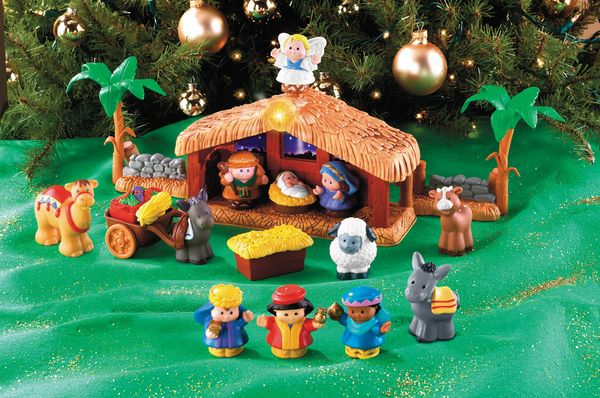
    I am very thankful for the “Little People” that Fisher Price puts out—especially the biblical ones. My father-in-law recently got my daughter Claire the Little People Nativity Set and she loves it. I can tell because they all are covered in baby slobber half the time. Baby Jesus is currently in a cocoon of solidified saliva.

    Fisher Price has done a good job of creating these cute, little people. The facial features, outfits, and color design—they all do a great job at setting the scene. Yet, the toys in and of themselves don’t communicate the story. They are the cast of characters, the set, and scene. There still needs to be a storyteller.

    Since we got this Nativity set, my wife and I sit with Claire and tell her the story of Christmas. We grab the camel, 3 Wise Men, and have them talk to one another. We pick up the Wise Men and have them give Claire kisses so that she can see that they journey to share love to the Christ child. We take Joseph and Mary and have her stare at them and tell her (with made up voices) “Jesus is our precious child and we love Him this much…” This line is followed by Mary and Joseph kissing Claire all over and we don’t stop until she smiles. Next, comes baby Jesus with His painted golden halo and saliva cocoon. “I came into the world, Claire, for you! I love you so much…” More kisses, more smiles from Claire.

    As a Youth Worker I am saddened to see how many of our young people either don’t care or are bored by the story of the God who became man. In the last 13 years, I’ve realized that our young people don’t care or are bored by the story because we have stopped telling the story well. There is a lack of excitement, joy, and wonder in the telling of this story.

    The storytelling has become dull. Think about it. How many times have you heard people talk about the Christmas story as if it were just another of BuzzFeed’s top 25 list, a matter of fact type thing that just is. “God became man. Can you pass the potato salad?”

    Claire smiles and laughs when baby Jesus kisses her—she is introduced and becomes a part of the story. My wife and I change our voices, we place Jesus on top of the couch, sometimes He is on the Christmas Tree, or on the dog’s head. The story must be told with new ardor, new methods and new expressions so that it captures her attention. It is and will always be the same story, but the listener needs to hear it in fresh new ways. The ardor, enthusiasm, passion, etc. must be palpable. We are talking about the GOD who BECAME a MAN!! This story and the time uncle Willie used poison ivy at camp to clean his backside should not stand toe-to-toe with each other. The method and expression in which we share the story has to be fresh, especially for those of us who have heard the story so many times that it really doesn’t do anything for us. This doesn’t mean we change the story—we cannot—but, the way in which we tell it should be new. Paint/art, music, film, food, etc. are ways to tell the story. Humanity is so creative (click on the blue text)! We can come up with new methods easily; we just need to use our imagination and talents.

    Claire will outgrow the baby Jesus kissing method and expression. My wife and I will need to come up with other creative ways to tell the story. Let’s face it, reading it from Scripture to her at the age of 1 or 2 isn’t going to capture it for her. The story must be told over and over again. When our children begin to show that they do not care or are bored with the story of God becoming man, it means we are not telling the story well.

    May this story never seize to capture the imagination of our children. May you and I never seize to tell it well, because it is the greatest story ever told.

    Merry Christmas to all of you and your loved ones.

  • Are you lying to your children about Santa?

    santa-shh

    This is a post from a blog I follow called The Radical Life by Matthew Warner. Matthew gave me permission to post on my blog. It is one of the best responses I have seen to the whole do we tell kids about Santa or not.

    Enjoy!

    LEO

    Disclaimer: Just so everyone’s clear…if you choose not to “do Santa,” I don’t think you’re a grinch out to ruin the magic of your kids’ childhood. In fact, in my experience, you’re most likely an outstanding parent whose thoughtfulness should be commended. Every child should be so blessed. I just think many parents struggle with aspects of Santa that really shouldn’t be struggles at all. In fact, I think they’re big opportunities. Here are some thoughts…

    My wife and I play a game with our two year old son. It involves catching a fish. You never know if it’s gonna be a little, tiny fish – or a great, big whale of a fish. You can play this game on the bed, on the floor, pretty much anywhere.

    To begin, you have to look very carefully all around you to try and find a fish just under the surface of the water. Once you spot one, you try to snatch it out of the water with your bare hands! But you have to be quick – because fish are very quick.

    Once you’ve caught a fish, it’s a bit of a juggling act. The fish is usually squirming and flopping around – as a fish out of water does. So it’s usually quite a struggle and a workout to keep the fish from getting away, especially if it’s a big one! The fish is very hard to hold on to – as fish are very slippery. Once you start getting tired of trying to hold on to this jumping, squirming fish, you pass him off to another person so they can wrestle with it for awhile. Eventually, the fish gets away and you start over again. It’s hilarious, just ask my son!

    Now, is the existence of the fish in this goofy game a part of an elaborate lie? Of course not. We were just using our imagination and teaching our son to do the same. We also showed him how using our imagination lets us have a lot of fun with very little. More importantly, we used our imagination to learn about something that is very, very real. Just because we imagine something doesn’t mean it’s not real. We imagine real things all the time.

    Does my two year old fully understand the difference between our fishing game and real fishing yet? Not quite. But one day he will. And in the process he’s learning a lot of real things about real fish…even if we exaggerate and have some fun with it in the process. (Note: this is not supposed to be an analogy for Santa, it’s to point out that what is “real” in the mind of a child is established in a very abstract way over years of their life…and that the distinction of precisely which parts and in which ways those parts are “real” or “not real” is, first, not a simple black and white answer and, second, something clarified over time…and that’s okay. Our insistence on immediately and forcefully classifying every thing neatly as either factually true or a lie is “an impoverished understanding of the nature of language, of thought, and of truth.”)

    So what about Santa Claus?

    We live in a culture that has taken Christ out of Christmas. Our appetite for material goods is insatiable. Our religion, a cult of consumerism. Our dogma, the marketing maxims of slick sales execs that have redefined for us what it means to be “prepared” for Christmas. Rather than prayer, fasting and repentance, we prepare by just buying lots of stuff. And they’ve made Santa Claus the spokesperson.

    So it’s no surprise that, as a reaction to all that, some have been tempted to throw Santa Claus right out and get back to the “reason for the season.” And besides, why do we tell such “lies” to our kids about some imaginary man in a sleigh anyway?

    Well, I’ll tell you.

    First, the story of Santa Claus is a Christian story. Hello! When told properly, it points to and emphasizes Jesus Christ. So, it’s actually one of the (fun) ways to “get back to the reason for the season.” And kids like fun.

    Second, therefore, Santa Claus is not the problem. The commercialization of Christmas has victimized him as much as any of us. In fact, I’m pretty sure the real Santa Claus isn’t taking all of this too lightly, either.

    Which brings me to my next point, Santa Claus is a real person. So it’s not a lie to say that Santa Claus is real. He has died, yes. But he’s not really dead. He’s alive in heaven, which means he’s more fully alive than any of us.

    Santa Claus = Sinter Klaas = Sint Nikolaas = Saint Nicholas. Make it a lesson in linguistics for your kids. Santa means Saint. A Saint is someone who has lived a life of heroic virtue. A life worth mimicking. A life worth observing. A life worth learning from. A life that points to Christ.

    Saint Nicholas was a 4th century bishop in the Church. And his spirit of giving and serving the poor is worth remembering by re-enacting (and imagining) his life and then learning from it. More importantly, the reason he served the poor and gave of himself so much is because he served Christ at the center of his life. And he did so with heroic enough virtue that we remember it thousands of years later. We are all called to live lives like that. That’s the radical call of being a Christian (not necessarily to dramatically cast out all the fun in our lives!).

    The point is that Santa can’t just be somebody we get stuff from.

    He’s a kind of model for our life – just like every “Saint.” He’s somebody we can teach our kids to look at and say, “do you see how generous and giving he is? That’s what God calls us to be every day, and especially during this important religious season when we celebrate the greatest gift mankind has ever received, Jesus.”

    The giving must be emphasized, not the receiving. But you can’t have one without the other! So the question for our family is, simply, which are we focused on? and therefore, what are our kids learning is most important? The giving…or the receiving?

    And it’s okay if your 4 year old gets more excited about Santa than she does about baby Jesus. That probably means you have a healthy 4-year-old who can’t grasp the magnitude and deep theological significance of redemption, eternal salvation and God becoming a man. Even most adults struggle with it. Let’s not strip the fun out of our kids’ lives because they realize a jolly fat man in a red suit who flies around in a sleigh with magical reindeer giving gifts is more exciting than a baby in a manger. Any religion that wants to last longer than a single generation must acknowledge this simple childhood truth.

    We just have to make sure that as kids get older they continue to learn the depth of the Santa story as they are able. And how that jolly fat man who gives presents is not there to give us presents, but to show us how to give. And he’s not doing so because you’ve been good, he’s doing so because giving is what life is all about. And the most radical way that old Saint Nick lived this out was not with the gift of presents, but with the giving of his entire life to Jesus Christ and the way he lived it in service to Him.

    Personally, I think we should tell the Santa story to our children the same way we tell any great story. Let them pretend along with you. Let them learn in time what is true about the story and what isn’t. What is important about the story and what isn’t. And more importantly, help them learn the deeper (and very real) truths contained within it. And along with that, of course, use it to help them understand the infinitely more significant and completely true story of Jesus.

    Does that mean your kids might not buy the whole story – hook, line and sinker? Maybe. Let them question. But also let them wonder. A child’s wonder should be kindled to flame, not stamped out with the cold hard facts as quickly as possible.

    Let them wonder.

    But to be clear, it is not the goal here at all to deceive our kids, it’s to tell the great story. Too many parents get this backwards. They get too caught up on trying to make their kids literally believe every bit of it. That’s not the point. And, for me, that can easily become lying, which is never good. Be honest with them, but don’t let the wrong details distract them.

    Just look at the book of Genesis. If you read the story of creation and get caught up on whether everything was made in 6 literal days or not, you’re missing the whole point of the story. The writer didn’t feel the need to clarify certain obvious questions of *fact* when telling that story. Does that mean they were intending to deceive? Not at all. They were telling a better story and teaching a more important truth in the process.

    I get it.

    It’s a legitimate criticism that the story of Santa too often overshadows the story of Jesus. It’s so true. And that must be corrected. Yes, the feast of St. Nicholas on Dec. 6 should be the main time we celebrate Saint Nick. But the fact is that a feature of our culture, whether we like it or not, is that Santa helps us celebrate Christmas. We can co-opt and run with that, or we can opt out and waste a big opportunity. I think the former is what the Church has done repeatedly throughout history with much success.

    Let the malls and the advertisements and the chatter and pictures of Santa be like the pages of a great story book come to life and we’re all characters! I think we’ll have more success reminding people of the reason for the season if we join in the drama rather than opt out.

    Do we need more Jesus inserted into the mix? Absolutely. At every turn. And He must remain central to the overall narrative we teach our children during this time of year. But don’t bail on Santa. If you look close enough, his jolly red suit is a giant red arrow pointing straight to Jesus. We just have to make sure and follow the arrow when it shows up.

    We’ve become boring story tellers.

    Our modern scientific minds have turned us into impotent story tellers. Telling stories is an art performance, not a repeating of scientifically verifiable facts. There are lots of ways to tell this story without lying to our kids. If your conscience is bothering you about it, then it probably means you should be telling the story a little differently.

    I like to think of it this way. When we read a good bed time story, we read it like it’s real because it’s more fun and impactful that way. You learn more and it exercises the imagination. But at the end when your kid asks, “is that really real, Daddy?” the answer is rarely as simple as a yes or no.

    Do princesses and castles exist? Yes, honey. Does princess Jasmine? well, no. Or maybe she did exist, but this story is only partially true about her. Or maybe she never existed, but the situations in the story are real. Maybe the scene is made up but the lesson is not. Does magic exist? No, not really. But do some moments in life feel magical? Absolutely. Are super heroes real? Yes, although they may look differently than you think. Dad, does anyone really have special powers? Yes, but not like you are thinking…better ones, that you’ll only think are better when you’re older and wiser.

    You have to be the judge on how much you answer now or allow to be answered in time. When your child asks “Is Santa really real?” a simple yes or no is not sufficient. If they are ready, maybe you tell them which parts are real and which aren’t and explain right then at a level they can understand. Or, maybe you ask them what they think and you let them think about it for awhile. Maybe you let them think about it for years. But it’s still a story worth telling.

    A child’s mind is such a dynamic place – and forming it doesn’t happen in a single moment. With Santa, instead of finding out the full story immediately in one sentence, maybe they find it in good time as they are ready (like every good story you’ll ever tell them).

    It makes for a fun story when we let Santa eat the cookies and deliver the presents. But kids soon learn that Santa had a few partners along the way to get the job done.

    Good myths are the ones we grow in to – not out of.

    And if that’s not enough, read why G.K. Chesterton still believes in Santaand this now-classic wondrous response to Virginia.

  • Fully Alive: Part II – Waking the Dead

    coffin 002

    So complacency has led us to not live our lives to the full. Complacency has in many ways stolen our ability to see what this fullness even looks like.  Worse of all, complacency has stolen our heart—the one thing we need to be fully alive.

    How did this happen? How is it possible that we could have our hearts taken from us? Here is the thing, our heart is not something that can be taken from us—we give it away.

    We hear the phrase, “He/She stole my heart” all the time. The reality is that when we say that phrase what we really mean is that we gave that person access to our heart and they did something with it—good or bad. My daughter has stolen my heart in the sense that I am so in love with her. That love is so strong that it physically feels like she has my heart in her hands. Another example can be a girlfriend who you have given your heart to that breaks it and causes it to ache. That pain is so strong that it physically feels like she has taken your heart but in this case has done harm to it.

    We give our heart over to people and things. Some of these people or things never should have had access to our heart and this, is how we lose it. Here are some examples:

    • The man who goes online to watch porn. He gives those images permission to access his heart. He lets them in and those images speak to his heart in a destructive way.
    • The man who chooses work over family because he’s successful there. His heart connects to work more so, and family loses the rightful place of that heart.
    • The man who plops himself in front of a TV connected to a X-box and plays shoot ‘em up games till 4am. His mind tells his heart he is “saving the world” but it’s virtual—fake.
    • The man who has no control over food and eats everything and anything placed before him. His heart longs for pleasure and satisfaction but its disordered.

    These are just some of many ways we give our heart away. I’m sure you can come up with others yourself.

    To whom, or to what have you given your heart to? And does this person or thing deserve to have it?

    I have been thinking, wrestling and praying about those two questions for a long time and the answer is: I have given my heart away to things that do not deserve to have it. Those things suck the life out of my heart and have led me to complacency, this sort of zombie like state I mentioned in my last post.

    I recently watched this movie called Warm Bodies. It’s a zombie comedy that has a really interesting twist to the zombie situation.  In the movie a zombie pandemic consumes the whole world. There are a few humans who are surviving and fighting the zombies. The movie follows R, who is a young zombie that really doesn’t know what he is doing, how he became a zombie, or why he is living at an airport. R feels…dead. Yet, he knows there is something out there, something more to his current state.

    Eventually R meets a human named Julie and this is where things get interesting. Julie’s company does something to R that begins to change him. R recognizes that Julie is beautiful, strong and that her presence begins to wake him up from the inside out. R starts to become human again. He is reclaiming his humanity and the way he does this is through whom he gives his heart to. R falls in love with Julie and love awakens him. By the time the movie gets to the end R protects Julie from a fall and as they get up they both realize that R has woken from the dead—he is fully alive. R comes back from this zombie-like-complacent-state due to his desire to love the right thing; in this case it is a person—Julie. R reclaims his heart by giving it to Julie and he comes back to life.

    Giving our hearts to the wrong things leads to death. Giving our hearts to the right things helps us to be fully alive. This is how we reclaim our heart. We love the right person, the right things.

    So what does this have to do with fatherhood?

    To be a good father I must be the best version of myself—that is who God has called me to be. To be fully alive is the best thing I could ever be for my family. To be anything else is simply unacceptable.

    So rise up men! Reclaim your heart. Wake the dead. Be who God has called you to be.

    Because the glory of God is you fully alive.